Medically reviewed by Dr. Alexander Matz, MD, FRCSC, FACS, founder of Canada Vein Clinics.
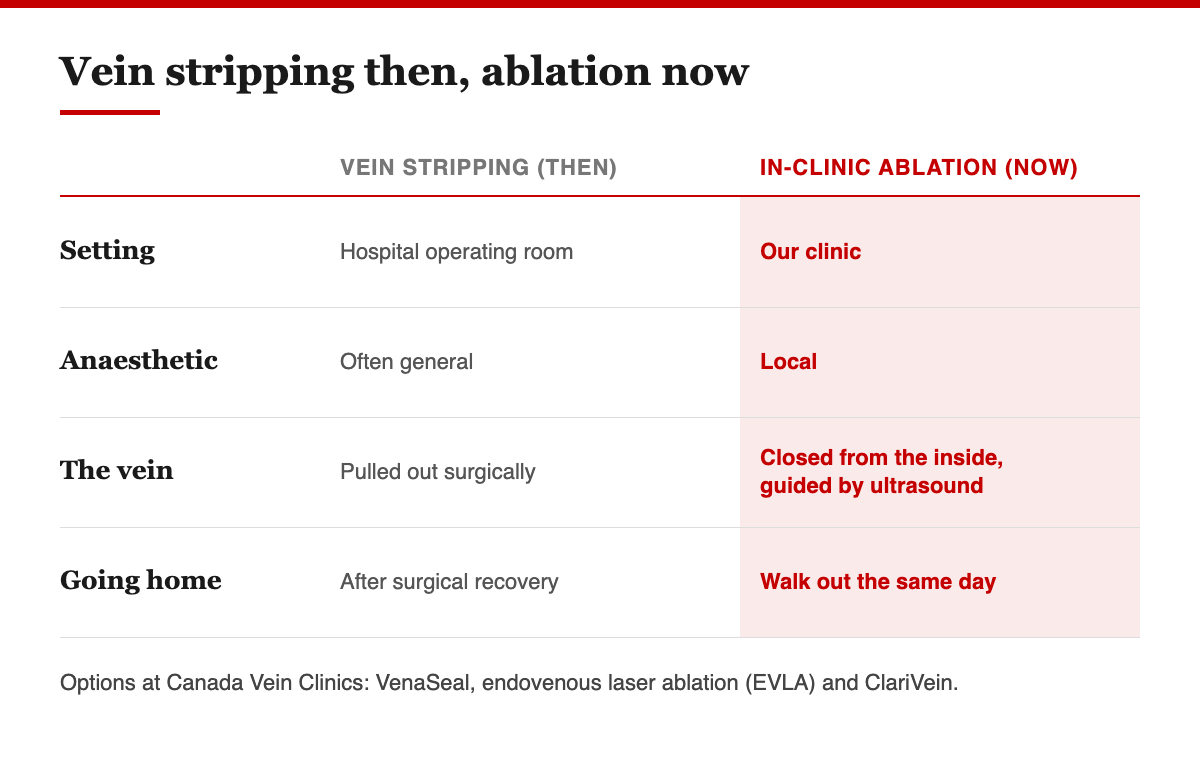
The biggest change is that leaking veins no longer have to be pulled out in a hospital: today they are closed from the inside, in clinic, under local anaesthetic, and you walk out the same day. That shift, from vein stripping to vein ablation, has changed what treatment for varicose veins looks like for patients.
Why the vein needs treatment at all
Leg veins have one-way valves that keep blood moving up toward the heart. When those valves fail, blood flows backward and pools in the leg, which is called reflux. The visible varicose veins are often fed by a larger leaking vein deeper under the skin. Treating that source vein is the goal of both stripping and ablation. The difference is how it is done, and what that means for your day.
What vein stripping was
For many years, the standard treatment was surgery. In vein stripping, the leaking vein was pulled out of the leg in a hospital operating room, often under general anaesthetic. Patients then needed time to recover from an operation, which often meant time away from work and daily routines. Because the cure sounded worse than the problem, many people with aching, swollen legs simply put off treatment.
What vein ablation is
Ablation takes a different approach. Instead of removing the vein, the physician closes it from the inside, guided by ultrasound. Once the leaking vein is closed, blood finds its way back to the heart through healthy veins. Ablation is done in our clinics under local anaesthetic, and patients walk out the same day.
The treatments we use today
- VenaSeal closes the vein with a medical adhesive and uses no heat. It is the treatment we perform most often.
- Endovenous laser ablation (EVLA), also called EVLT, closes the vein using laser energy.
- ClariVein is another non-heat option for closing the vein.
- Sclerotherapy, including VeinLite-guided sclerotherapy, treats smaller veins.
Your physician recommends the option that fits what your ultrasound shows. Not every vein suits every treatment, which is why the assessment comes first.
Experience across both eras
Canada Vein Clinics founder Dr. Alexander Matz, MD, FRCSC, FACS, is a general surgeon with more than 20 years in vein care. He was among the first in Canada, and the first in Atlantic Canada, to perform endovenous laser ablation. Having seen both eras of treatment, he built our clinics around in-clinic care that lets patients get back to their day.
How it starts
Every assessment begins with a duplex ultrasound, done while you stand by our ultrasound technician, before your consultation with the physician. Please bring shorts. The physician then reviews the scan with you and explains your options. If treatment is recommended, you receive a written cost estimate before anything is booked. On treatment day, the vein is mapped again with a mapping ultrasound to plan the treatment.
In Ontario, the ultrasound and consultation are covered by OHIP with a referral. In Nova Scotia, the consultation is covered by MSI with a referral, and in New Brunswick it is currently covered by Medicare with a referral. Treatment is paid, and many patients use a Health Spending Account toward the cost.
Your next step
If you put off treatment years ago because surgery was the only option, it may be worth another look. If a parent or grandparent once had their veins stripped, your experience today would look very different. Ask your family doctor or nurse practitioner for a referral to Canada Vein Clinics, or call 1-888-876-8346. We have 15 clinics across Ontario, Nova Scotia and New Brunswick; find the one nearest you.