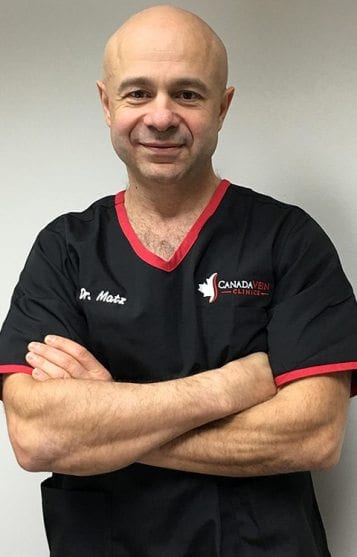
Vein treatment looks nothing like it did a generation ago. Where surgical vein stripping once meant a hospital operating room and weeks of recovery, most patients today are in and out of a clinic in under an hour with minimally invasive options like laser ablation, ClariVein, and VenaSeal. We sat down with Dr. Alexander Matz, founder of Canada Vein Clinics, to talk about that shift.
What did treating varicose veins look like when you started?
When I started, treating varicose veins usually meant surgery — vein stripping and ligation in a hospital operating room, often under general anesthetic. Patients could expect significant bruising, difficulty walking for some time afterward, a few weeks off work, and a high rate of complications. Worst of all, after going through such a devastating surgery and recovery, there was a very high chance the problem would come back. Stripping disrupts the anatomy of the venous system and triggers neovascularization — the growth of new veins that become new sources of varicose veins. Many people with symptoms put off treatment for years simply because the cure sounded worse than the problem.
What was the turning point toward minimally invasive treatment?
I was trained as a minimally invasive surgeon, and it was very disturbing to me that we could treat so many conditions with minimally invasive methods — but not varicose veins. So the appearance of endovenous ablation treatments at the beginning of the 21st century brought a true revolution to phlebology, the field that treats chronic venous insufficiency and varicose veins.
First came laser and radiofrequency ablation, and later non-thermal options like ClariVein and VenaSeal. Instead of removing the vein, we could close it from the inside through a tiny needle entry, guided by ultrasound, under local anesthetic. Once we saw patients walking out of the clinic and back to normal life the next day, with outcomes as good as or better than surgery, it was clear this was the new standard of care.
What do patients misunderstand most about vein treatment today?
The biggest misconception is that varicose veins are just a cosmetic problem. For many people they’re a sign of venous insufficiency — a circulation problem that tends to get worse over time and can lead to swelling, skin changes, and even ulcers. It can lead to blood clots as well. The second is that treatment is painful or requires a hospital stay. Today most procedures take under an hour in the clinic, and most patients go back to their usual activities within a day or two.
Where do you see vein treatment heading next?
I expect treatment to become even less invasive and more comfortable, with more non-thermal options that don’t require numbing along the vein. Ultrasound imaging keeps getting better, which helps us catch venous disease earlier and tailor treatment to each patient. My hope is that more people come in at the early stage — when treatment is simplest — rather than waiting until symptoms become serious or they develop complications.